Barma drola
The Eight Mountains: A NovelBarma drola is a ruined building site on a wooded terrace above a lake, where a white rock face meets snow, shaped stones, and a young Swiss pine. Left to Pietro by his father, the place becomes more than property: it is the unfinished home Giovanni Guasti intended Bruno to build, a memorial to Giovanni, and the ground on which Pietro and Bruno make their friendship tangible again.
Setting and Name
When Pietro reaches the site in winter, snow has altered the shape of the slope, but the terrace remains discernible beneath it. A high, unusually white rock wall faces the lake. Three remnants of dry-stone walls emerge from the snow: two short walls and a longer front wall defining a footprint of four by seven meters. The rock face itself formed the fourth wall and supplied the stone. The roof has disappeared, while a small Swiss pine has taken root among the rubble and grown to the height of the surviving walls. Pietro sees the inheritance in its stark elements: rock, snow, stones, and tree.
The place is identified as Barma drola, a name Bruno says he learned from his mother, who remembers local names reliably. Pietro tests the sound of the name by calling the pale formation “The strange rock.” The landscape does not offer the calm refuge of a finished house: rain and snow mingle, the mountains disappear into cloud, and the place’s beauty strikes him as somber and anguished. Its unfinished, exposed character is integral to the inheritance he must decide what to do with.
Giovanni’s Plan and Pietro’s Inheritance
Barma drola had already mattered to Giovanni before Pietro knew what he had inherited. Bruno recalls that he and Giovanni had searched for sites together for some time. When they came upon this one in September, Giovanni chose it immediately, despite having seen many possible locations. The discovery was nearly three years before Pietro’s arrival. Bruno then had to locate the owners and persuade them to sell, an unusually difficult task in a mountain community where people might keep a ruin for life rather than sell it to someone who intended to use it.
The inheritance is closely bound to Giovanni’s private history in the mountains. At home, Pietro finds his father’s old map still pinned to the wall, transformed by two decades of additions from a valley-trail map into a dense record of excursions. The black, red, and green routes eventually disclose a code: black marks Giovanni’s journeys, red accompanies Pietro on their high climbs, and green represents Bruno. Numerous routes combine Giovanni’s and Bruno’s colors, a discovery that stirs Pietro’s jealousy even as it comforts him to know his father spent years walking with someone. The map gives Barma drola a wider context: Giovanni’s wish to build there belonged to a life in the mountains that Pietro had only partly known.
At the ruin, Pietro recognizes the contradiction in his inheritance. Giovanni had spent his life fleeing houses, yet had wanted to build one on this particular mountainside. He could not complete the project, but arranged for the place to pass to Pietro and asked Bruno to build the house as he had designed it. Bruno offers to work during the summer, explaining that he had promised Giovanni to carry out the plan. Pietro initially objects that he has little money left after settling his disastrous finances, and does not want to spend what remains on construction. The site therefore confronts him not only with his father’s intention but with a real choice about whether to accept it.
Building as Memory and Shared Home
After hearing his mother’s account of the family past, Pietro understands his father through the image of the glacier: summer melts snow and erases traces, while the glacier preserves the snow of winters long gone. He distinguishes the father he knew in the city from the mountain walker who followed him on paths and loved glaciers. Giovanni’s ruin becomes a way to remember that less familiar father, and Pietro decides to complete the work rather than leave the inheritance as a pile of stones.
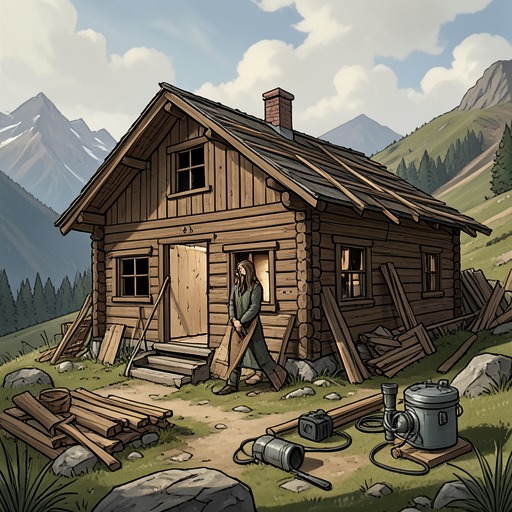
The house that Pietro and Bruno build preserves a practical openness appropriate to a mountain refuge. Its sturdy front door has a latch but no lock; only the stone room containing equipment is secured against theft. The wooden room remains open so that a passerby in difficulty can find shelter. Around it, the grass is cut like a garden and firewood is stacked beneath a lean-to. Pietro replants the small pine by the lake, though it appears no stronger than it did among the original rubble. The transformation is substantial, but the fragile tree carries the site’s continuity from ruin into habitation.
Memorial and Shared Inheritance
On a short September day, Pietro brings his mother up from Grana. Wearing the same leather hiking boots she has had since his childhood, she climbs for two hours at a slow, steady pace without stopping. Inside the finished house, Bruno has lit the stove; she drinks tea by the window and looks out over the lake, scree, and peaks of Grenon. She also studies the house and terrace carefully, as if committing them to memory.
The day before, Pietro had carved Giovanni’s name and dates into the rock wall and painted the inscription black: “IN MEMORY IS THE MOST BEAUTIFUL REFUGE”. His mother pauses before it, then calls on Pietro and Bruno to sing the song traditionally sung for a dead lover of the mountains, asking that he be allowed to keep walking in the afterlife. The memorial joins the physical rock to a family act of remembrance. Pietro then tells his mother, so that she can witness and remember the decision, that the house should belong not to him alone but to him and Bruno together. He believes this is what Giovanni wanted, but also says that it is what he wants because they built the house together. Barma drola thus changes from a father’s unrealized plan and a son’s solitary inheritance into a shared home, while remaining open to other travelers who may need shelter.